Chapter 3

This section describes Lord Rama’s journey to Mithila with Sage Vishwamitra and the unfolding of key events that define the Ramayana.

Sargas 64–66 describe Rama’s arrival in Mithila and the introduction of the sacred Shiva Dhanush in King Janaka’s court.

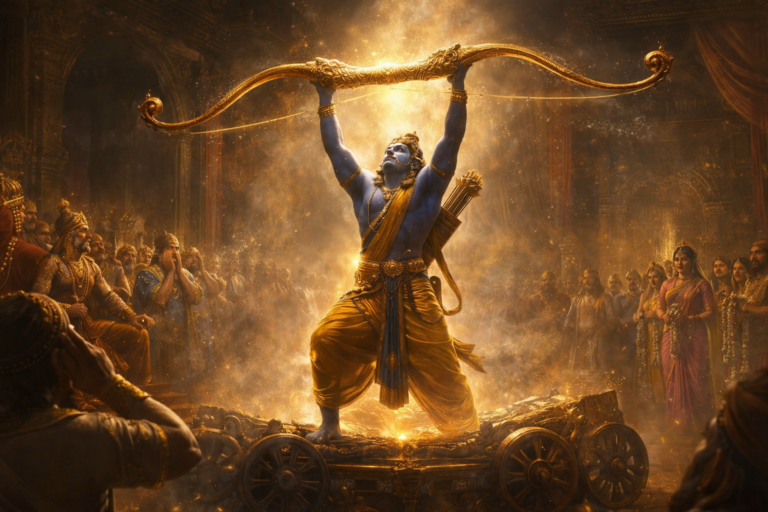
Sargas 67–68 focus on Sita’s swayamvara, where Rama lifts and breaks the bow (Dhanurbhanga), demonstrating his divine strength.

Sargas 69–73 describe the marriage of Rama and Sita, marking the union of dharma and destiny.

It contains many Sargas, only selected Sargas are explained in detail,  and readability and to  make users discover other aspects of Lord Rama not projected in T.V serials untill now

Vishwamitra Shows Mithila’s Spiritual Significance

Mithila – The City of Dharma

मिथिला नगरी रम्या जनकेनाभिपालिता ।
धर्मेण पालयामास सर्वलोकहिते रतः ॥
Translation:

The beautiful city of Mithila, ruled by King Janaka, was governed with righteousness and dedicated to the welfare of all beings.

🧠 Context:

👉 Shows Mithila as an ideal dharmic kingdom, peaceful and spiritually advanced.

👉    Mithila was a peaceful and happy kingdom because the king followed dharma and cared for everyone.

Reference: Bala Kanda, Sarga 66

King Janaka’s Dharmic Nature

जनको नाम धर्मात्मा मिथिलायां प्रतिष्ठितः ।
यज्ञशीलः महातेजा धर्मज्ञः सत्यविक्रमः ॥

 
Translation:

King Janaka, a righteous soul, ruled in Mithila. He was devoted to sacred rituals, spiritually powerful, and deeply knowledgeable in dharma.

🧠 Context:

Establishes Janaka as an ideal king rooted in dharma, not just Sita’s father.

Why This Matters:
Rama was not just traveling — he was learning how a perfect kingdom should be ruled.

.Reference:

Bala Kanda, Sarga 66

Assembly of Kings for Swayamvara

तत्र राजानः बहवः समेता जनकालये ।
धनुर्दर्शनकाङ्क्षिणः सीतायाः स्वयंवरे ॥


🌐 Translation:

Many kings gathered in the court of Janaka, eager to witness the bow and participate in Sita’s swayamvara.

🧠 Context:

Highlights the importance and grandeur of Mithila and the swayamvara event.
Discipline Over Power: Rama’s Approach

1. Permission Before Power

👉 Rama does not touch the bow immediately
👉 He waits for:

  • Guru’s approval
  • Proper moment

Meaning:
✔ Power must be guided by discipline
✔ Dharma comes before action

Calm Mind Before Great Action

👉 No excitement
👉 No aggression
👉 No ego

✔ Completely composed

Meaning:
👉 Great actions come from inner stillness, not impulse

Lord Rama lifting the bow

Lifting the bow

Dhanurbhanga – The Breaking of Shiva’s Bow

Instead of lifting it, Rama has just applied pressure. One end is braced against his foot, and his body is in motion, recoiling from the force. The bow has snapped in the middle, releasing a visible shockwave and dust.

The Iron Carriage

Rama stands over the fractured pieces of the bow, which is now resting on the broken halves of its massive, eight-wheeled iron transport carriage. The carriage itself is a complex machine of ancient iron, rivets, and dark, heavy wood, clearly showing the scale required to move it.

💍 Rama–Sita Marriage – The Union of Dharma

Janaka Offers Sita to Rama

इयं सीता मम सुता सहधर्मचरी तव ।
प्रतिच्छ चैनां भद्रं ते पाणिं गृह्णीष्व पाणिना ॥

🌐 Translation:

“This is my daughter Sita, who will walk with you in dharma. Accept her, O Rama, and take her hand in yours.”

🧠 Context:

This is the most important marriage verse, where King Janaka gives Sita to Rama.

📌 Reference:
Bala Kanda, Sarga 73

Sacred Union Begins

प्रतिगृह्य तु तां सीतां रामः सत्यपराक्रमः ।
पाणिं जग्राह विधिवत् तदा तस्याः शुभानने ॥

🌐 Translation:

Rama, true to dharma and valor, accepted Sita and held her hand according to sacred rites.

🧠 Context:

Describes the actual moment of marriage ritual (Pāṇigrahaṇa).

This was not just a marriage — it was the union of dharma and destiny.

📌 Reference:
Bala Kanda, Sarga 73

Sita – The Inner Strength Behind Gracee

. 🕊️ Unwavering Dharma

Sita always follows righteousness, no matter the situation.
👉 She stands firm in dharma even during hardship.


2. 💪 Inner Strength

She is mentally strong and unbreakable.
👉 Her strength is silent but powerful.


3. ❤️ Conscious Devotion

Her devotion to Rama is thoughtful and willing.
👉 She chooses dharma, not dependency.


4. 🌼 Purity of Mind

Sita is free from ego, hatred, and negativity.
👉 Her purity comes from inner clarity.


5. 🤝 Equality in Partnership

She walks beside Rama as a sahadharmacharini.
👉 She represents equal participation in dharma.

Scroll to Top